← Cinematique Visual Effects & Promptable FX · Intermediate

Forced Perspective Prompt for AI Image & Video

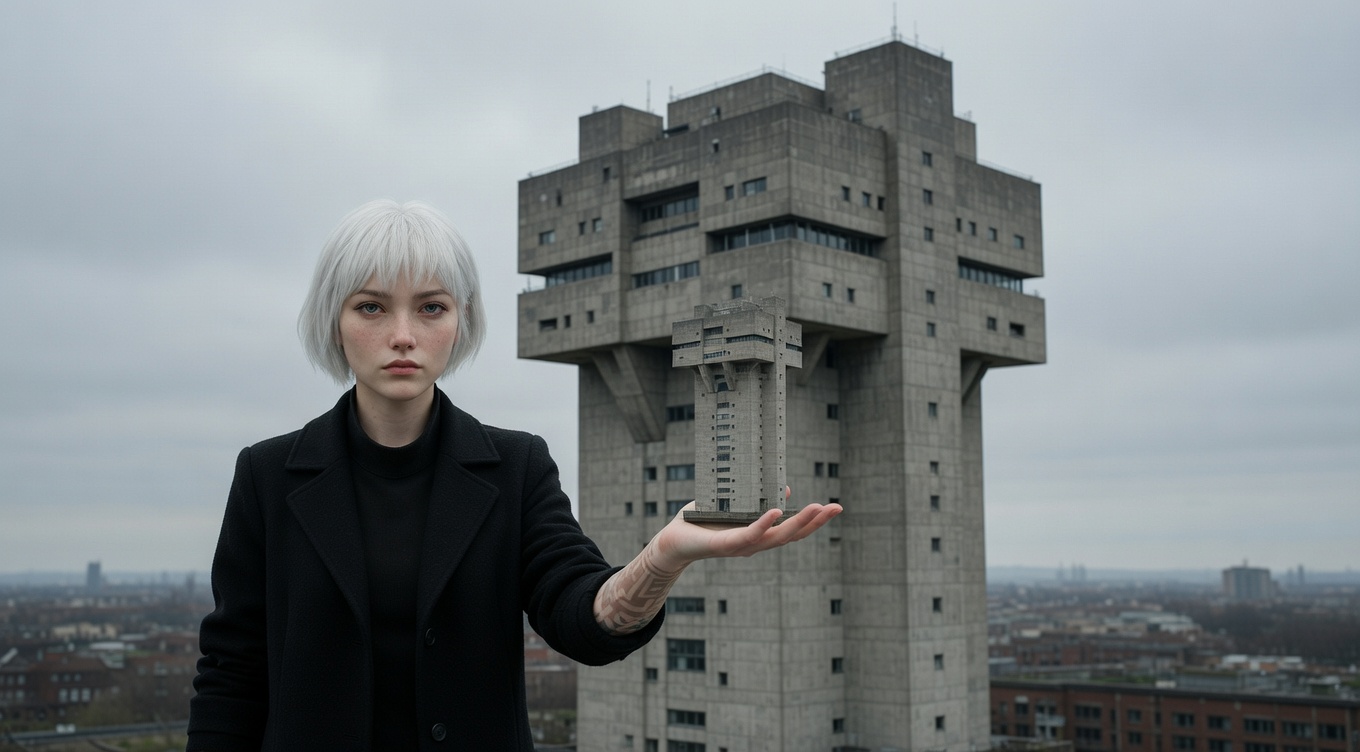
Forced Perspective cinematic example

Using the relationship between camera position and object placement to create optical illusions of size — Hobbits appear small next to Gandalf through precise staging rather than CGI. Peter Jackson used forced perspective extensively in "The Lord of the Rings," building oversized and undersized duplicate sets and using precise camera alignment to make Elijah Wood appear four feet shorter than Ian McKellen in the same frame. Jean-Pierre Jeunet used forced perspective for whimsical effect in "Amélie." The technique dates back to the earliest days of cinema and architecture — Egyptian temples and Baroque churches used the same principle to appear larger than they are.

By Ivan Flugelman · Reviewed 16 July 2026

Prompt template

Forced perspective illusion with [Subject] appearing impossibly large or small through precise camera alignment and placement, the depth of field deep enough that both near and far elements appear sharp, the lighting matching between foreground and background, the Peter Jackson technique of making the impossible look real without digital manipulation, just physics and precise alignment

Replace [Subject] with your own character or scene. The prompt is technology-agnostic and works as a starting point for AI image or video generators.

When to use Forced Perspective

Use forced perspective when characters or objects must appear impossibly large or small while sharing one believable frame. It suits fantasy scale, whimsical comedy, giant-object illusions, and practical-looking visual tricks. The technique works from a precise viewpoint, so it is strongest in composed shots with controlled blocking. Avoid wide camera movement unless the alignment and depth relationship can remain locked throughout.

Directing the AI

Place the larger-looking subject close to camera and the smaller-looking subject farther away on the same sightline. Use deep focus so both planes remain sharp, then match light direction, color temperature, shadow softness, and eye lines across the distance. Hide scale references that expose the separation. Keep the camera fixed at the alignment point. For interaction, choreograph gestures to meet visually in the frame even though the subjects occupy different depths.

Common mistakes

  1. Allowing shallow focus to reveal that the apparently adjacent subjects sit on widely separated depth planes.
  2. Including familiar scale references between subjects, exposing the distance trick before the illusion can work.
  3. Moving the camera away from the designed viewpoint, causing edges, eye lines, and apparent contact to separate.
Sources and further reading

  1. Inventing Worlds and Characters: Effects — Academy Museum
  2. Stories of Cinema — Academy Museum

A technique is one decision. A world is the system.

Fog, smoke, dust and haze are not effects. They are the layer that decides how far you can see, and therefore how large the world is.

Read Atmosphere in full, free, or start with the thirteen fundamentals for building consistent characters, environments, visual logic, and stories that expand beyond one beautiful frame. There is also World Building Codex 3.0, free, and the World Building Academy.

Related techniques

Deep Focus

Everything in the frame — foreground, middle ground, and background — is in sharp focus simultaneously, allowing the viewer to explore the entire image and discover relationships between planes. Orson Welles and Gregg Toland made deep focus the defining visual innovation of "Citizen Kane" (1941), composing shots where action in the foreground, middle ground, and background all demanded simultaneous attention. William Wyler used deep focus in "The Best Years of Our Lives" to create some of cinema's most layered compositions. Jean Renoir's deep-focus staging in "Rules of the Game" lets multiple storylines play out in a single frame. The technique gives audiences agency — André Bazin argued it was more democratic than montage.

Worm's Eye View

Camera placed at ground level looking straight up, the most extreme low angle, making everything tower above and creating a sense of awe, intimidation, or childlike wonder. Orson Welles was famous for his low-angle work in "Citizen Kane" and "The Trial," often requiring sets to be built with ceilings — unusual for the era. Terry Gilliam employs worm's eye views in "Brazil" and "12 Monkeys" to make bureaucratic architecture oppressive. Denis Villeneuve used ground-level upward shots in "Arrival" when the characters first approach the alien ship, capturing the vertigo of encountering something incomprehensibly vast.

Mise-en-Scène

The total arrangement of everything visible in the frame — set design, props, costumes, lighting, actor positioning — where every element is a deliberate storytelling choice. The concept originates from French theater and was elevated to an art form by directors like Max Ophüls in "The Earrings of Madame de..." and Jean Renoir in "The Rules of the Game." Kubrick's obsessive mise-en-scène in "2001" and "Eyes Wide Shut" treats every prop and color as narrative text. Wes Anderson's mise-en-scène is so controlled it becomes the primary vehicle of storytelling, while Bong Joon-ho's "Parasite" uses the physical layout of the house as a map of class structure.

Color Grading

The process of altering and enhancing color in post-production to create a specific mood, era, or visual identity — the final paintbrush of cinema, transforming raw footage into visual art. The Coen Brothers' "O Brother, Where Art Thou?" (2000) was the first major film to be entirely digitally color graded, creating its sepia-toned Depression-era look. David Fincher works obsessively with colorist Stephen Nakamura to achieve the sickly green-yellow palette of "Se7en" and the cold precision of "Zodiac." Steven Soderbergh used radical color grading in "Traffic" — amber for Mexico, blue for the US, natural for Ohio — as a narrative device. Modern colorists like Company 3's Stefan Sonnenfeld and Technicolor's Peter Doyle are as essential to a film's look as the cinematographer.

Desaturation

Reducing color intensity in the image, moving toward grayscale to create a bleak, documentary, or dreamlike quality — partial desaturation can isolate a single color for dramatic effect. Steven Spielberg used near-total desaturation in "Schindler's List" with the famous exception of the girl's red coat, creating one of cinema's most iconic selective-color moments. Ridley Scott desaturated "Black Hawk Down" for combat realism. "Sin City" by Robert Rodriguez uses radical desaturation with selective color to recreate Frank Miller's graphic novels. Janusz Kamiński's desaturated look for "Saving Private Ryan" established the visual template for modern war films.

Sepia Tone

A warm brownish-yellow color treatment that evokes aged photographs and historical periods, instantly signaling "the past" and adding a romantic, weathered quality. The sepia effect mimics the actual chemical toning process used on photographs from the 1860s through the early 1900s. The Coen Brothers used a digital sepia grade throughout "O Brother, Where Art Thou?" to evoke Depression-era America. Spielberg used sepia-tinted bookend sequences in "Saving Private Ryan." Jean-Pierre Jeunet's "A Very Long Engagement" and Baz Luhrmann's period films use warm sepia tones to romanticize historical settings. The technique has become visual shorthand for memory and nostalgia.

Film Grain

The visible texture of chemical film stock — random variations in density and color that give analog footage its organic, tactile character, often added digitally for warmth and nostalgia. Christopher Nolan and Quentin Tarantino remain committed to shooting on actual film stock, preserving the authentic grain of celluloid. Steven Soderbergh shot "Traffic" on different film stocks to differentiate storylines. Modern digital films frequently add film grain in post-production — David Fincher, despite shooting digitally, adds carefully calibrated grain to every frame. The resurgence of film grain aesthetics in photography and video reflects a cultural desire for the organic imperfection that digital capture eliminates.

Bokeh

The aesthetic quality of out-of-focus areas, particularly light sources that become soft, circular orbs — beautiful bokeh creates a dreamy, luminous background that elevates any subject. The term comes from the Japanese word for "blur," and the quality of bokeh varies dramatically between lens designs. Anamorphic lenses produce distinctive oval bokeh, seen in J.J. Abrams' "Star Trek" and Ridley Scott's "Blade Runner." Wong Kar-wai and Christopher Doyle exploit bokeh as a primary aesthetic element in "In the Mood for Love." The rise of large-sensor cameras has made cinematic bokeh accessible to independent filmmakers, and the distinctive bokeh of vintage lenses has driven a renaissance in legacy glass from Helios, Canon K35, and Cooke Speed Panchro.

Lens Distortion

Optical aberrations from specific lenses that bend, stretch, or warp the image — wide-angle barrel distortion, anamorphic oval bokeh, or vintage lens flaring — each lens has a personality. Emmanuel Lubezki exploits wide-angle distortion in his work with Terrence Malick, using ultra-wide lenses that bend the edges of reality. Roger Deakins prefers Arri/Zeiss Master Primes for their clinical precision, while Robert Richardson often chooses older, imperfect glass for its character. The anamorphic distortion of Panavision C-series and E-series lenses — their signature flares, edge softness, and oval bokeh — has become synonymous with the "cinematic look." Modern lens designers at Cooke, Arri, and Zeiss carefully engineer specific amounts of controlled aberration.