← Cinematique Camera Work · Intermediate

Whip Pan Prompt for AI Image & Video

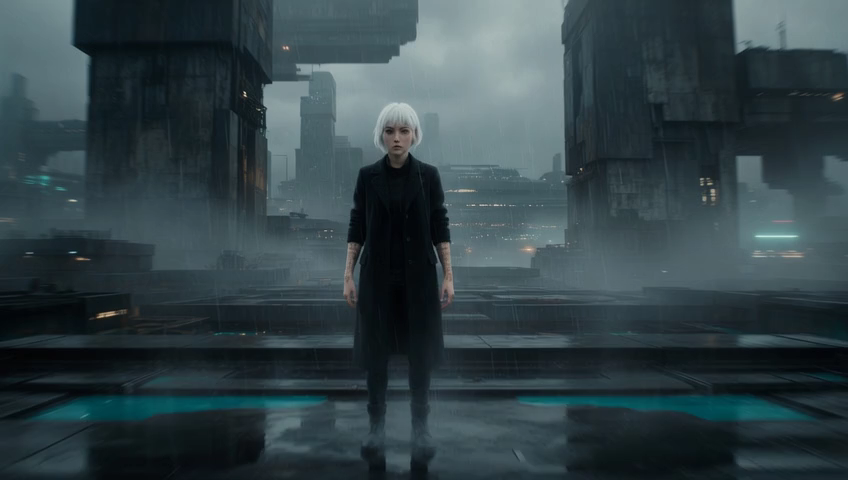
Whip Pan cinematic example

An extremely fast horizontal pan that creates motion blur, used as a dynamic transition or to convey sudden surprise, rapid shifts of attention, or frenetic energy. Edgar Wright made the whip pan his comedic signature in "Shaun of the Dead," "Hot Fuzz," and "Baby Driver," using them as rapid-fire visual punchlines. Sam Raimi employed frantic whip pans in the "Evil Dead" trilogy to convey demonic energy, and Damien Chazelle used precise whip pans in "Whiplash" to match the violent tempo of jazz drumming. Paul Thomas Anderson uses them as elegant transitions between scenes in "Boogie Nights."

By Ivan Flugelman · Reviewed 16 July 2026

Prompt template

Whip pan snapping to [Subject], heavy horizontal motion blur streaking the environment into abstract ribbons of color, the blur lasting just three frames before resolving into razor sharpness, shot on high-speed camera with a 35mm Zeiss Master Prime, raw visceral kinetic energy

Replace [Subject] with your own character or scene. The prompt is technology-agnostic and works as a starting point for AI image or video generators.

When to use Whip Pan

Choose a whip pan for a sudden shift of attention, a visual punchline, an impact, or a high-energy transition between connected spaces. Its brief blur can hide a cut or compress the distance between subjects. The destination must justify the snap. Use it as punctuation inside controlled coverage; constant whip pans make the scene noisy and erase the surprise that gives the move force.

Directing the AI

Define the sharp starting frame and an equally sharp landing frame on a second subject. Snap the camera horizontally between them, allowing only a few frames of heavy directional streaking before the image resolves. Keep blur aligned with the movement rather than radial or random. Match subject height and motion direction if the pan masks a transition. Hold briefly after landing. The move should read as one decisive operator reaction, not a continuous rapid scan.

Common mistakes

  1. Leaving the endpoint vague, causing the camera to stop on empty space or a subject that never resolves sharply.
  2. Applying blur before and after the movement, which removes the crisp contrast that gives a whip pan impact.
  3. Using radial zoom streaks instead of horizontal motion blur, confusing the technique with a crash zoom.
Sources and further reading

  1. 50+ Types of Camera Shots, Angles, and Techniques — StudioBinder
  2. Types of Camera Movements in Film Explained — StudioBinder

A technique is one decision. A world is the system.

Where the camera stands is not a setting, it is an argument about who has power and how large the world is.

Read Composition in full, free, or start with the thirteen fundamentals for building consistent characters, environments, visual logic, and stories that expand beyond one beautiful frame. There is also World Building Codex 3.0, free, and the World Building Academy.

Related techniques

Pan Shot

A horizontal rotation of the camera on a fixed axis, sweeping left or right to reveal the breadth of a space, follow lateral movement, or connect subjects across a scene. John Ford's slow, reverent pans across Monument Valley in "The Searchers" established the landscape as a character. Jean Renoir pioneered fluid panning in "The Rules of the Game," and Paul Thomas Anderson uses methodical lateral pans in "There Will Be Blood" to survey the oil fields with the deliberate gaze of a prospector scanning for fortune.

Crash Zoom

A sudden, rapid zoom into a subject for dramatic emphasis, often used for comedic punchlines, horror reveals, or martial arts impact moments. The crash zoom is a staple of Hong Kong martial arts cinema, used by directors like Lau Kar-leung and Chang Cheh in Shaw Brothers productions to punctuate kung fu strikes. Quentin Tarantino pays homage to this in "Kill Bill," and Edgar Wright uses crash zooms for comedic shock in his Cornetto trilogy. Sam Raimi made the crash zoom a horror signature — the camera hurtling toward a screaming face in the "Evil Dead" films became one of the genre's most recognizable moves.

Smash Cut

An abrupt, jarring cut between two vastly different scenes — often from quiet to loud, calm to chaos, or a character saying "nothing could go wrong" to everything going wrong. Edgar Wright is the modern master of the smash cut, using it for comedic whiplash throughout "Shaun of the Dead" and "Hot Fuzz." Kubrick's smash cut from the bone to the satellite in "2001" is the most dramatic temporal smash cut in cinema. The Coen Brothers use smash cuts for dark comedy in "Fargo" and "No Country for Old Men," and David Lynch uses them in "Mulholland Drive" to shatter the viewer's sense of narrative stability.

Aerial Shot

A shot captured from high above the ground, typically using a drone or helicopter, providing a sweeping view of landscapes, cityscapes, or large-scale action. The aerial perspective conveys omniscience, freedom, or the terrifying scale of nature. David Lean pioneered epic aerial work in "Lawrence of Arabia," while Ridley Scott used helicopter shots to establish the grandeur of ancient Rome in "Gladiator." More recently, Denis Villeneuve employed haunting aerial compositions in "Sicario" to reveal the eerie geometry of border landscapes.

Bird's Eye View

A shot taken from directly overhead, looking straight down on the subject, creating a god-like perspective that can make subjects appear small and insignificant or reveal patterns invisible from ground level. Busby Berkeley pioneered the technique in 1930s musicals, choreographing dancers into kaleidoscopic geometric formations seen from directly above. Darren Aronofsky used it extensively in "Requiem for a Dream" to convey psychological detachment, and Wes Anderson frequently employs overhead shots of meticulously arranged objects as a signature compositional device.

Close-Up

A tightly framed shot that fills the screen with a subject's face or a specific detail, revealing emotions, textures, and subtle details invisible in wider shots. Carl Theodor Dreyer's "The Passion of Joan of Arc" (1928) is built almost entirely from devastating close-ups of Renée Falconetti's face, widely considered the greatest performance ever captured on film. Sergio Leone elevated the close-up to operatic intensity in his Westerns, while Jonathan Demme's direct-to-camera close-ups in "The Silence of the Lambs" created unbearable intimacy with Hannibal Lecter.

Dutch Angle

A shot where the camera is tilted on its roll axis, creating a diagonal horizon line to convey unease, disorientation, tension, or a character's disturbed psychological state. Carol Reed made the Dutch angle iconic in "The Third Man" (1949), tilting nearly every frame in the Vienna sewers to mirror the moral corruption of Harry Lime. Tim Burton adopted it as a signature style in "Batman" and "Edward Scissorhands," while Kenneth Branagh used it relentlessly in "Thor" to evoke the comic-book panels of Jack Kirby.

Dolly Shot

A smooth camera movement where the entire camera physically moves toward, away from, or alongside the subject on a wheeled platform or track, creating an immersive sense of movement through space. Orson Welles used dolly shots to navigate the deep-focus interiors of "Citizen Kane," while Spike Lee invented his signature double-dolly shot — mounting both actor and camera on the same platform — to create a floating, surreal glide seen in "Do the Right Thing" and "25th Hour." Martin Scorsese's famous Copacabana shot in "Goodfellas" tracks Henry Hill through the back entrance of a nightclub in one fluid dolly movement.

Establishing Shot

A wide shot typically used at the beginning of a scene to set the context, showing the location, time of day, and spatial relationships before cutting to closer action. Stanley Kubrick's establishing shots in "The Shining" — the Overlook Hotel dwarfed by mountains — immediately communicated isolation and foreboding. Ridley Scott's opening of "Blade Runner" established a dystopian Los Angeles with a single, unforgettable wide shot of industrial hellscape. David Fincher meticulously crafts establishing shots that embed narrative information into every architectural detail.