← Cinematique Camera Work · Basic

Tilt Shot Prompt for AI Image & Video

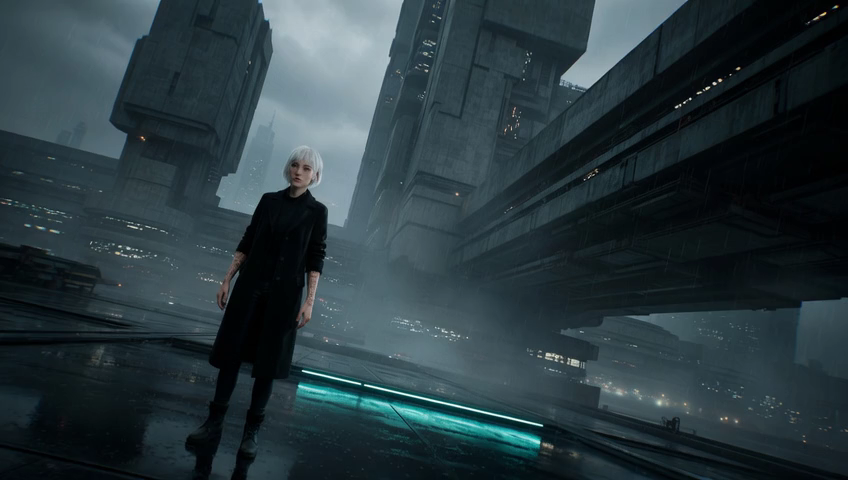
Tilt Shot cinematic example

A vertical rotation of the camera on a fixed axis, tilting up or down to reveal height, scan a character from feet to face, or follow vertical action. Hitchcock used the slow tilt masterfully in "Psycho," tilting up the facade of the Bates house to establish its Gothic menace. Spielberg opens "Jurassic Park" with a slow tilt up the Brachiosaurus that mirrors the characters' awe, and Christopher Nolan employs precise tilts in "Inception" to disorient the viewer as architecture folds upon itself.

By Ivan Flugelman · Reviewed 16 July 2026

Prompt template

Slow tilt shot beginning at the feet of [Subject] and climbing vertically up their body, the deliberate vertical scan building anticipation, each detail telling the character's story before the face is revealed, shot on 85mm telephoto compressing the vertical layers, Kodak Vision3 500T with cool overcast color rendition

Replace [Subject] with your own character or scene. The prompt is technology-agnostic and works as a starting point for AI image or video generators.

When to use Tilt Shot

Use a tilt when attention needs to travel vertically while the camera stays in place. A slow rise from boots to face can delay identity; a move up a facade can establish intimidating height; a downward tilt can reveal danger, evidence, or a body below. The start and finish should form a meaningful relationship. Avoid tilting when physical camera elevation or a wider static frame communicates the idea more clearly.

Directing the AI

Fix the camera on its support and specify a vertical rotation upward or downward with no lateral travel. Name the starting detail, the visual information encountered during the move, and the final reveal. A telephoto perspective can compress stacked details during a character scan, while steady speed builds anticipation. Keep horizontal framing stable and avoid roll. For video, let the tilt resolve and hold briefly on the destination so the revealed face or object registers.

Common mistakes

  1. Confusing tilt with raising the camera, which changes viewpoint and parallax instead of rotating on a fixed axis.
  2. Starting and ending on unrelated details, leaving the vertical scan with no dramatic logic or visual payoff.
  3. Tilting too fast for costume, architecture, or environmental clues to register before the final reveal.
Sources and further reading

  1. 50+ Types of Camera Shots, Angles, and Techniques — StudioBinder
  2. Types of Camera Movements in Film Explained — StudioBinder

A technique is one decision. A world is the system.

Where the camera stands is not a setting, it is an argument about who has power and how large the world is.

Read Composition in full, free, or start with the thirteen fundamentals for building consistent characters, environments, visual logic, and stories that expand beyond one beautiful frame. There is also World Building Codex 3.0, free, and the World Building Academy.

Related techniques

Pan Shot

A horizontal rotation of the camera on a fixed axis, sweeping left or right to reveal the breadth of a space, follow lateral movement, or connect subjects across a scene. John Ford's slow, reverent pans across Monument Valley in "The Searchers" established the landscape as a character. Jean Renoir pioneered fluid panning in "The Rules of the Game," and Paul Thomas Anderson uses methodical lateral pans in "There Will Be Blood" to survey the oil fields with the deliberate gaze of a prospector scanning for fortune.

Crane Shot

Camera mounted on a mechanical crane arm that sweeps upward, downward, or across a scene with majestic, controlled movement, often used for dramatic reveals or grand establishing moments. Orson Welles opened "Touch of Evil" with one of cinema's most famous crane shots — a continuous three-minute take following a car bomb through a Mexican border town. The final crane shot of "Gone with the Wind" pulling back to reveal hundreds of wounded soldiers remains one of Hollywood's most iconic images. Brian De Palma used elaborate crane work in "The Untouchables" for the Union Station staircase sequence, and Steven Spielberg's crane shots in "Schindler's List" shift from intimate to devastating in scale.

Low Angle Shot

Camera positioned below the subject, looking up, making the subject appear dominant, powerful, heroic, or imposing. Orson Welles used low angles obsessively in "Citizen Kane," famously requiring trenches cut into studio floors to achieve extreme upward perspectives on Charles Foster Kane, visually encoding his megalomania into every frame. Quentin Tarantino's iconic trunk shots — looking up at characters from inside a car trunk — are a playful variation, and Christopher Nolan used low angles throughout "The Dark Knight" to make Batman a towering mythic figure against Gotham's skyline.

Aerial Shot

A shot captured from high above the ground, typically using a drone or helicopter, providing a sweeping view of landscapes, cityscapes, or large-scale action. The aerial perspective conveys omniscience, freedom, or the terrifying scale of nature. David Lean pioneered epic aerial work in "Lawrence of Arabia," while Ridley Scott used helicopter shots to establish the grandeur of ancient Rome in "Gladiator." More recently, Denis Villeneuve employed haunting aerial compositions in "Sicario" to reveal the eerie geometry of border landscapes.

Bird's Eye View

A shot taken from directly overhead, looking straight down on the subject, creating a god-like perspective that can make subjects appear small and insignificant or reveal patterns invisible from ground level. Busby Berkeley pioneered the technique in 1930s musicals, choreographing dancers into kaleidoscopic geometric formations seen from directly above. Darren Aronofsky used it extensively in "Requiem for a Dream" to convey psychological detachment, and Wes Anderson frequently employs overhead shots of meticulously arranged objects as a signature compositional device.

Close-Up

A tightly framed shot that fills the screen with a subject's face or a specific detail, revealing emotions, textures, and subtle details invisible in wider shots. Carl Theodor Dreyer's "The Passion of Joan of Arc" (1928) is built almost entirely from devastating close-ups of Renée Falconetti's face, widely considered the greatest performance ever captured on film. Sergio Leone elevated the close-up to operatic intensity in his Westerns, while Jonathan Demme's direct-to-camera close-ups in "The Silence of the Lambs" created unbearable intimacy with Hannibal Lecter.

Dutch Angle

A shot where the camera is tilted on its roll axis, creating a diagonal horizon line to convey unease, disorientation, tension, or a character's disturbed psychological state. Carol Reed made the Dutch angle iconic in "The Third Man" (1949), tilting nearly every frame in the Vienna sewers to mirror the moral corruption of Harry Lime. Tim Burton adopted it as a signature style in "Batman" and "Edward Scissorhands," while Kenneth Branagh used it relentlessly in "Thor" to evoke the comic-book panels of Jack Kirby.

Dolly Shot

A smooth camera movement where the entire camera physically moves toward, away from, or alongside the subject on a wheeled platform or track, creating an immersive sense of movement through space. Orson Welles used dolly shots to navigate the deep-focus interiors of "Citizen Kane," while Spike Lee invented his signature double-dolly shot — mounting both actor and camera on the same platform — to create a floating, surreal glide seen in "Do the Right Thing" and "25th Hour." Martin Scorsese's famous Copacabana shot in "Goodfellas" tracks Henry Hill through the back entrance of a nightclub in one fluid dolly movement.

Establishing Shot

A wide shot typically used at the beginning of a scene to set the context, showing the location, time of day, and spatial relationships before cutting to closer action. Stanley Kubrick's establishing shots in "The Shining" — the Overlook Hotel dwarfed by mountains — immediately communicated isolation and foreboding. Ridley Scott's opening of "Blade Runner" established a dystopian Los Angeles with a single, unforgettable wide shot of industrial hellscape. David Fincher meticulously crafts establishing shots that embed narrative information into every architectural detail.