← Cinematique Camera Work · Basic

Slow Motion Prompt for AI Image & Video

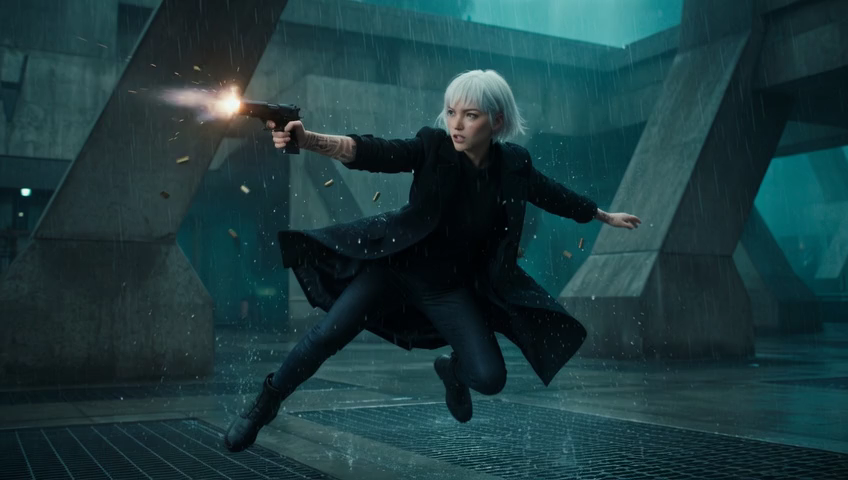
Slow Motion cinematic example

Footage captured at a higher frame rate than playback speed, stretching time to reveal details invisible at normal speed and amplifying impact, beauty, or emotional weight of a moment. Sam Peckinpah revolutionized screen violence with the slow-motion bloodbath of "The Wild Bunch," making destruction simultaneously beautiful and horrifying. The Wachowskis' "bullet time" in "The Matrix" became a cultural phenomenon, while Zack Snyder made speed ramping — shifting between slow and normal motion — his signature in "300." Wong Kar-wai uses slow motion with step-printing in "In the Mood for Love" to transform a woman walking past a noodle stand into pure visual poetry.

By Ivan Flugelman · Reviewed 16 July 2026

Prompt template

Slow motion capture at 240fps of [Subject] suspended in a single stretched moment, dust particles hanging motionless in shafts of light, every fine detail frozen in crystalline clarity, shot on Phantom Flex4K high-speed camera with Zeiss Master Prime glass, time stretched until a single second becomes an eternity of beauty

Replace [Subject] with your own character or scene. The prompt is technology-agnostic and works as a starting point for AI image or video generators.

When to use Slow Motion

Apply slow motion when a brief action contains detail or emotional weight that normal speed would hide. Impacts, fabric movement, water, dust, a fall, or a tiny facial response can become readable and monumental. It can make violence beautiful, grief suspended, or athletic motion analytical. Reserve it for selected beats; stretching routine movement without contrast often drains urgency instead of intensifying it.

Directing the AI

Choose one action and describe it as high-frame-rate capture played back slowly, with a clear beginning, peak, and release. Ask for crisp micro-detail in particles, hair, fabric, or debris while allowing natural directional blur on the fastest edges. Keep the camera move simpler than the subject action. State the perceived duration so one second expands meaningfully rather than freezing. Lighting should be strong enough to define each suspended element against the background.

Common mistakes

  1. Slowing an action with no hidden detail or emotional turning point, making the sequence feel padded rather than heightened.
  2. Removing all motion blur and producing a brittle sequence of frozen poses instead of continuous high-speed capture.
  3. Combining extreme slow motion with elaborate camera movement that distracts from the physical event being examined.
Sources and further reading

  1. 50+ Types of Camera Shots, Angles, and Techniques — StudioBinder
  2. Types of Camera Movements in Film Explained — StudioBinder

A technique is one decision. A world is the system.

Where the camera stands is not a setting, it is an argument about who has power and how large the world is.

Read Composition in full, free, or start with the thirteen fundamentals for building consistent characters, environments, visual logic, and stories that expand beyond one beautiful frame. There is also World Building Codex 3.0, free, and the World Building Academy.

Related techniques

Freeze Frame

Action suddenly stops as a single frame is held on screen — the exclamation point of cinema, used for endings, revelations, or comic emphasis. François Truffaut's freeze frame ending of "The 400 Blows" — young Antoine Doinel reaching the sea and turning to look directly at the camera as the image freezes — is one of cinema's most iconic final images. Martin Scorsese uses the freeze frame throughout "Goodfellas" as a storytelling device, and the final freeze frame of "Butch Cassidy and the Sundance Kid" immortalized its heroes mid-action. Spike Lee employs freeze frames with title cards as a recurring stylistic device.

Fast Motion

Footage played back faster than it was captured, compressing real-time action to create comedy, frenetic energy, or an accelerated sense of unstoppable momentum. Buster Keaton and Charlie Chaplin used undercranking to create the frenetic comedy of the silent era. Stanley Kubrick used fast motion for the threesome scene in "A Clockwork Orange" set to William Tell's Overture. Guy Ritchie employs speed ramping and fast motion in "Snatch" and "Lock, Stock and Two Smoking Barrels" as a signature stylistic device. Wes Anderson uses deadpan fast motion in montage sequences throughout "The Royal Tenenbaums" and "The Grand Budapest Hotel."

Time-Lapse

Capturing frames at intervals much slower than playback speed, compressing hours, days, or months into seconds to reveal processes invisible to normal perception — clouds racing, cities pulsing. Ron Fricke's "Koyaanisqatsi" (with Philip Glass's score) turned time-lapse into transcendent art, showing the rhythms of nature and civilization accelerated into hypnotic visual music. Terrence Malick uses time-lapse in "The Tree of Life" for cosmic creation sequences. David Fincher employed time-lapse in "Fight Club" and "The Curious Case of Benjamin Button" for both practical and poetic purposes. Modern nature documentaries by BBC and National Geographic have elevated time-lapse photography to a science.

Aerial Shot

A shot captured from high above the ground, typically using a drone or helicopter, providing a sweeping view of landscapes, cityscapes, or large-scale action. The aerial perspective conveys omniscience, freedom, or the terrifying scale of nature. David Lean pioneered epic aerial work in "Lawrence of Arabia," while Ridley Scott used helicopter shots to establish the grandeur of ancient Rome in "Gladiator." More recently, Denis Villeneuve employed haunting aerial compositions in "Sicario" to reveal the eerie geometry of border landscapes.

Bird's Eye View

A shot taken from directly overhead, looking straight down on the subject, creating a god-like perspective that can make subjects appear small and insignificant or reveal patterns invisible from ground level. Busby Berkeley pioneered the technique in 1930s musicals, choreographing dancers into kaleidoscopic geometric formations seen from directly above. Darren Aronofsky used it extensively in "Requiem for a Dream" to convey psychological detachment, and Wes Anderson frequently employs overhead shots of meticulously arranged objects as a signature compositional device.

Close-Up

A tightly framed shot that fills the screen with a subject's face or a specific detail, revealing emotions, textures, and subtle details invisible in wider shots. Carl Theodor Dreyer's "The Passion of Joan of Arc" (1928) is built almost entirely from devastating close-ups of Renée Falconetti's face, widely considered the greatest performance ever captured on film. Sergio Leone elevated the close-up to operatic intensity in his Westerns, while Jonathan Demme's direct-to-camera close-ups in "The Silence of the Lambs" created unbearable intimacy with Hannibal Lecter.

Dutch Angle

A shot where the camera is tilted on its roll axis, creating a diagonal horizon line to convey unease, disorientation, tension, or a character's disturbed psychological state. Carol Reed made the Dutch angle iconic in "The Third Man" (1949), tilting nearly every frame in the Vienna sewers to mirror the moral corruption of Harry Lime. Tim Burton adopted it as a signature style in "Batman" and "Edward Scissorhands," while Kenneth Branagh used it relentlessly in "Thor" to evoke the comic-book panels of Jack Kirby.

Dolly Shot

A smooth camera movement where the entire camera physically moves toward, away from, or alongside the subject on a wheeled platform or track, creating an immersive sense of movement through space. Orson Welles used dolly shots to navigate the deep-focus interiors of "Citizen Kane," while Spike Lee invented his signature double-dolly shot — mounting both actor and camera on the same platform — to create a floating, surreal glide seen in "Do the Right Thing" and "25th Hour." Martin Scorsese's famous Copacabana shot in "Goodfellas" tracks Henry Hill through the back entrance of a nightclub in one fluid dolly movement.

Establishing Shot

A wide shot typically used at the beginning of a scene to set the context, showing the location, time of day, and spatial relationships before cutting to closer action. Stanley Kubrick's establishing shots in "The Shining" — the Overlook Hotel dwarfed by mountains — immediately communicated isolation and foreboding. Ridley Scott's opening of "Blade Runner" established a dystopian Los Angeles with a single, unforgettable wide shot of industrial hellscape. David Fincher meticulously crafts establishing shots that embed narrative information into every architectural detail.